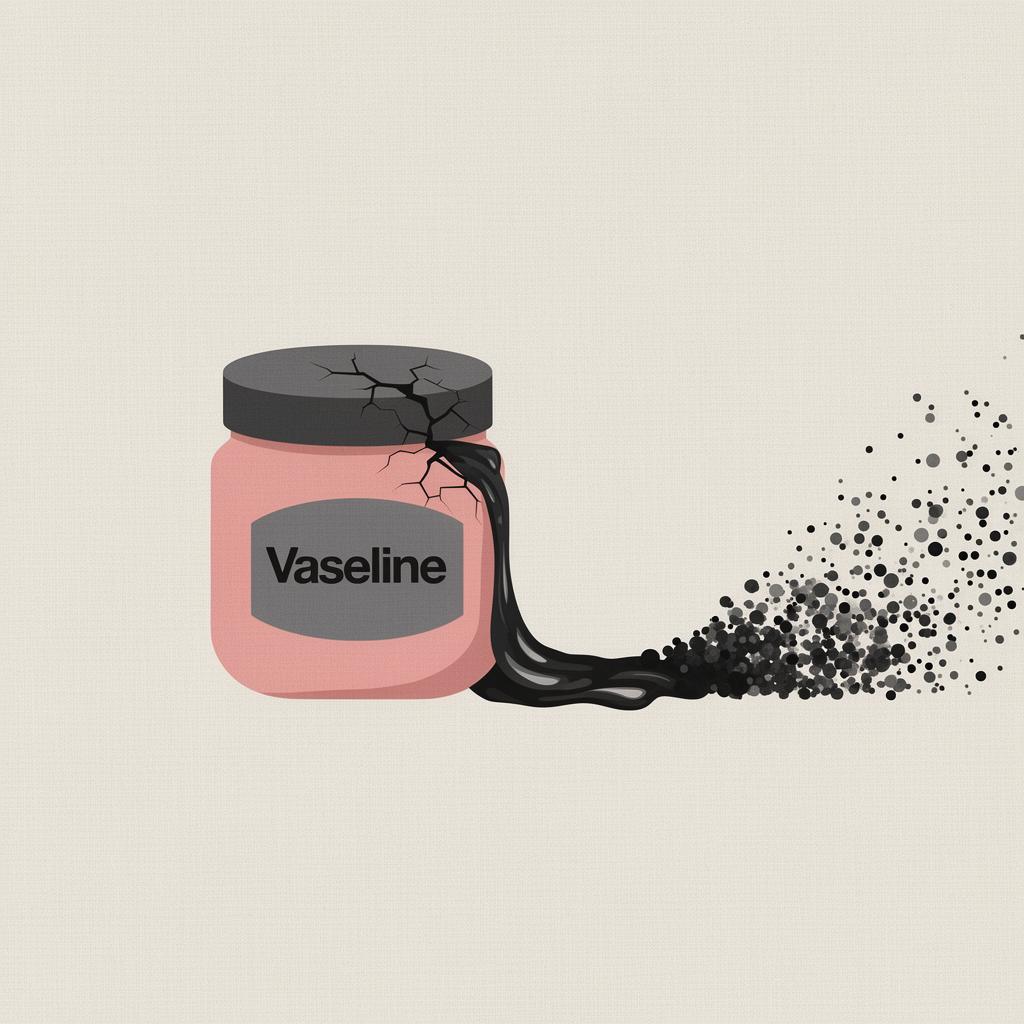
Vaseline has the perfect marketing position: it is so old, so cheap, and so universally recommended by grandmothers that nobody questions it any more. Cracked heels? Vaseline. Diaper rash? Vaseline. Lips? Vaseline. Tattoo aftercare? Vaseline.
It is also a refined byproduct of crude oil. That is not an insult. That is the literal manufacturing process.
The entire premise of the product is "what if we took the residue off oil rig drilling equipment and put it on a baby.
What petroleum jelly actually is
Petrolatum, the active and only ingredient in classic Vaseline, is made by collecting the waxy residue that forms on oil rig pumps, then deodorising and filtering it. In the United States and Europe the pharmaceutical-grade version is refined to remove polycyclic aromatic hydrocarbons (PAHs), which are known carcinogens. In many other markets — including significant parts of the global Unilever supply chain — that refinement is not independently verified.
Even the cleanest medical-grade petrolatum has a problem: it is occlusive without being breathable. It does not "moisturise". It seals whatever is underneath it — including bacteria, sweat, and any product you put on first — under a film your skin cannot metabolise.
The skin barrier myth
The reason Vaseline "works" on cracked skin is the same reason cling film "works": it blocks transepidermal water loss. That is genuinely useful for an acute wound. It is not a long-term skincare strategy. Sealing skin with petrolatum every day disrupts the lipid layer your skin is trying to build, which is why so many lifelong Vaseline users describe skin that "needs" it — the skin no longer produces its own oils properly.
A product that creates the problem it claims to solve is the holy grail of consumer goods.
For lips this is even more obvious. Chronic petrolatum users develop a dependency loop where the lips feel dry within minutes of not reapplying. That is not chapped lips. That is petrolatum withdrawal.
The supply chain story
Vaseline is a Unilever brand. The petroleum supply chain — even setting aside the climate argument — is one of the most opaque in personal care. Crude origin, refinement standard, and PAH testing vary by region. Unilever's public sustainability reporting on petrolatum sourcing is, generously, thin.
Meanwhile the alternatives — beeswax, shea, lanolin, plant oils — are agricultural products with traceable supply chains and zero fossil-fuel dependency. They cost more per gram because they are not literally drilling waste.
What "switching" actually looks like
For the same jobs Vaseline does, two products cover almost everything: a beeswax-and-plant-oil balm for hands, heels, and lips, and a rich whipped shea or seed-oil based all-purpose cream for dry patches, eczema, and post-shower skin. Both biodegrade. Both come in recyclable glass or aluminium. Both let your skin actually do its job.
For tattoo aftercare, ask the artist — most modern studios moved off petrolatum a decade ago and recommend a plant-based balm precisely because of the breathability problem.
The bigger pattern
Vaseline is the most honest of the Unilever brands in one sense: the product really has not changed in over a century. The marketing wraps it in nostalgia and "doctor recommended" framing, but the jar is the jar. Petroleum jelly is petroleum jelly.
The swaps below are listed as coming soon in the Codex shop. Empty the blue jar. Your skin will remember what it is supposed to do.
- Potency
- Mixed. As an occlusive it works — it is literally just petrolatum. But that is all it does.
- Bioavailability
- Mixed. Sits on the skin. Does not heal anything — it occludes so the skin can heal itself.
- Marketing vs hype vs reality
- Weak. 'Healing' framing for an inert by-product of crude oil refining.
- Sustainability
- Poor. Fossil-derived, non-renewable, packaged in single-use plastic.
- Ethics
- Weak. Unilever. The supply chain is the petroleum industry.
- Verdict
- Petroleum jelly with a 19th-century brand wrapper.