It’s a familiar ritual. You’re on the sofa, scrolling through a deck of faces, each one a neat summary of a human life. He’s holding a fish. She’s at Machu Picchu. And nearly all of them, it seems, have a little badge next to their name: ‘Fitness’. Or ‘Gym’. Or ‘Running’. You pause, thumb hovering. Does ‘running’ mean they’ve completed an ultramarathon, or that they once jogged for a bus in 2022? You swipe right, a speculative bet on a shared lifestyle.
The search for connection has become another form of digital consumption, a game of filtering and matching based on carefully curated data points. We perform our identities through these little tags, hoping the algorithm will decode our signals and deliver us a compatible partner. But as the lines between our digital and physical selves blur, a question emerges: are these tools actually helping us connect, or are they just another screen-bound distraction from the real work of building a community?
What's happening
For the better part of a decade, dating platforms from Bumble to Hinge have been integrating “interest badges” into profiles. The logic is sound: shared interests foster connection. By allowing users to display passions like ‘yoga’, ‘hiking’, or ‘weightlifting’, these apps provide another data point for the matching algorithm and another filter for the user. It’s an attempt to move beyond basic demographics and into the fuzzier, more meaningful realm of lifestyle compatibility.
This feature has become ubiquitous. It’s now standard practice to scan a profile not just for an engaging bio or flattering photos, but for that cluster of icons indicating a shared worldview. A ‘craft beer’ badge might suggest casual weekend hangs; a ‘politics’ tag, a certain kind of dinner-party conversation. The ‘fitness’ category, however, has become particularly prominent. It telegraphs health, discipline, and a certain kind of modern virtue. It’s a signal that you’re not just looking for a partner, but a teammate.
In response to the inherent limitations of this digital-first approach, a different model is gaining traction: the curated, activity-based social club. Enter concepts like The Codex Circle, an invite-only membership that organizes and books studio sessions and wellness events for a vetted group of individuals. This isn't about swiping; it's about showing up. The platform is merely the conduit to a real-world experience, a tool for coordinating presence in a physical space. It’s a deliberate shift from finding a person who says they like fitness to meeting people who do fitness.
Looking for the curated version? Codex skips the noise — verified coaches, studios and products surfaced through one AI intake. Teams running wellness budgets at scale can use Codex Credits for one wallet across every booking.
Why it matters now
The cultural timing for this shift is potent. We are living in the long shadow of peak screen time, with a pervasive sense of digital fatigue. The Global Wellness Institute (GWI) has noted for years that social connection is a critical pillar of well-being, yet our primary tools for finding it are often isolating. The loneliness epidemic isn’t a myth; it’s a documented public health concern, and swiping endlessly through profiles can feel more like reinforcing solitude than curing it. People are increasingly seeking what sociologists call “third places”—environments outside of home and work where community and spontaneous interaction can flourish. A spin class can be a much better third place than a dating app.
Furthermore, the economy of signals on dating apps has become inflated. A fitness badge is a “cheap signal”—it costs nothing to add to your profile. It doesn't prove commitment, only aspiration or, in some cases, outright performance. This leads to a low signal-to-noise ratio. You might match with ten people who list ‘hiking’ as an interest before finding one who will actually join you on a trail. Curated communities invert this. The cost of entry isn't a click, but a genuine commitment of time, energy, and resources. Showing up for a 7 AM HIIT class is a “costly signal.” It requires effort and proves intent, immediately filtering for people who share a real, tangible interest.
Declaring your love for fitness on an app is one thing; showing up for a 6 AM circuit class together is another entirely.
The comparison
At a glance, both systems claim to solve the same problem: connecting you with like-minded people. But their methodologies, philosophies, and outcomes could not be more different. It's a classic case of the map versus the territory.
The Arena: Digital vs. Physical
With a platform like Bumble, the entire interaction unfolds on your phone. The arena is the app's interface—a vast, asynchronous, and atomized digital space. You browse, filter, and chat in private, with the goal of eventually coordinating a one-on-one meeting. It’s a high-volume, low-friction system designed for scale. You can review hundreds of potential “connections” in the time it takes to drink your morning coffee.
The arena for The Codex Circle is a specific, hand-picked fitness studio, a tranquil retreat, or a challenging urban race. It is a physical place at a set time. The experience is synchronous and communal. Instead of pre-screening an individual, you opt into a pre-screened group event. The friction is higher—it requires booking, travel, and participation—but the context is richer. The focus shifts from individual evaluation to shared participation. You’re not there to assess someone’s dating potential; you’re there for a world-class workout. Everything else is secondary.
The Signal: Stated Interest vs. Demonstrated Commitment
The “fitness” badge on a dating profile is a claim. It’s a piece of self-reported data with no verification. It could mean the user is a professional athlete, or it could mean they bought a yoga mat in 2021 that is currently gathering dust. Because the signal is so cheap to produce, its value is diluted. It’s a conversation starter, perhaps, but a weak foundation for assuming genuine compatibility.
A system built around shared events relies on demonstrated commitment. The signal isn't a badge; it's the act of showing up. By booking a spot in an advanced pilates class or a weekend running club, members of The Codex Circle send a far more reliable signal. They demonstrate a willingness to invest time and effort into their well-being and social life. This isn't about saying you value fitness; it’s about valuing it enough to build your schedule around it. This costly signal acts as a powerful, authentic filter, ensuring that everyone in the room shares a baseline of intent.
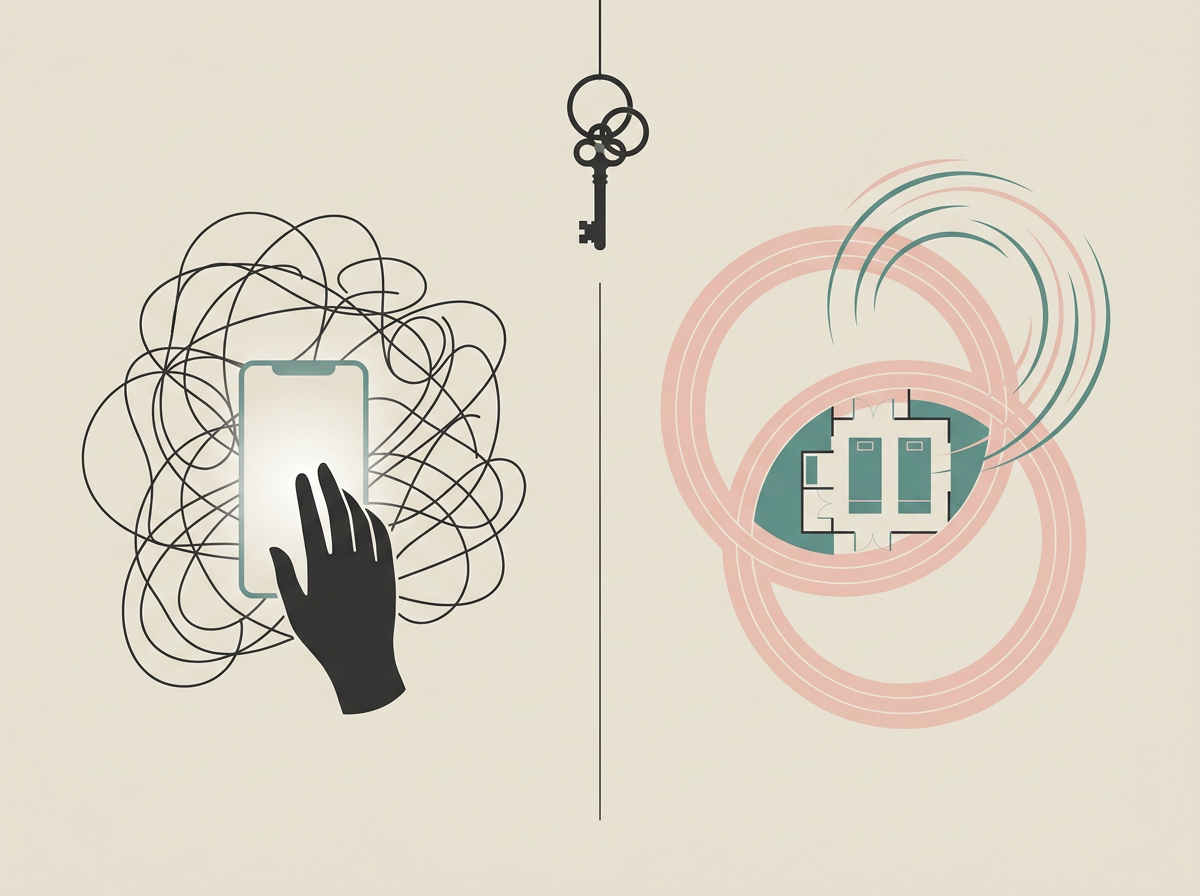
split-screen illustration phone versus studio class
The Vetting: Algorithmic vs. Curated
Dating apps vet through algorithms and user reporting. The software learns your preferences based on who you swipe on and attempts to serve you more of the same. It’s a numbers game, optimizing for engagement and potential matches. The platform’s definition of a “good” match is one that both users approve of, but it has no real stake in the quality of the subsequent interaction.
The Codex Circle, by contrast, is a curated community. Membership is by application or invitation. The vetting process is human-centric, designed not to find you a date, but to build a cohort of engaged, respectful, and interesting individuals who will elevate the experience for everyone else. The goal is to cultivate a specific culture—one of mutual respect, positive energy, and shared enthusiasm. The platform has a direct stake in the quality of the group dynamic because the event is the product. A bad actor doesn’t just ruin one person's date; they degrade the experience for the entire group.
The goal isn't finding 'the one.' The goal is having such a good time in a great space that you forget you were ever looking.
What this means for you
So, which should you choose? The answer, as always, depends on your objective. If your primary goal is romantic partnership and you want to cast the widest possible net, dating apps are powerful search engines. They allow you to efficiently filter a large population based on criteria that are important to you, with fitness being just one of many potential data points. They are tools for sourcing individual connections, and they can be effective if you have the patience and resilience to navigate the noise.
If, however, you’re experiencing swipe fatigue and looking to build a more organic social life, the calculus changes. If you want to connect with people in a lower-pressure environment, where the activity itself is the main event, then a curated social club is a more direct path. It’s for people who want to expand their community and meet others through shared passions, not just shared dating intentions. Platforms like The Codex Circle are designed to get you off your phone and into a room with interesting people. It’s a more patient, holistic approach to building a social world. For a deeper look at how different wellness platforms stack up, you can always consult our independent reviews.
Verdict
Bumble uses fitness as a feature to help you find a person. The Codex Circle uses people to enhance a fitness experience. One is a matching engine that lives in your pocket; the other is a key to a physical third place. Dating apps gamify the search for connection, while curated clubs facilitate the connection itself. Your choice depends on whether you’d rather spend your evening swiping for a workout partner or sweating alongside a dozen new ones.
FAQ
Is The Codex Circle a dating app?
No. The Codex Circle is an invite-only social club that organizes premium fitness and wellness experiences. While connections can form organically, its primary purpose is building community around shared activities, not romantic matchmaking.
How do you join The Codex Circle?
Membership to The Codex Circle is currently by invitation and application. This process helps curate a community of engaged individuals and ensures a high-quality experience for all members at our partner studios and events.
Are fitness filters on dating apps useless?
Not entirely. They can be a useful starting point for a conversation or a very broad filter. However, they are a 'cheap signal' and don't guarantee a genuine shared lifestyle or commitment level.
What is the main difference in outcome between these two approaches?
A dating app's ideal outcome is a successful one-on-one match that moves from the app to real life. A social club's ideal outcome is a successful group event where members have a positive shared experience, strengthening the community, with individual connections being a potential bonus.