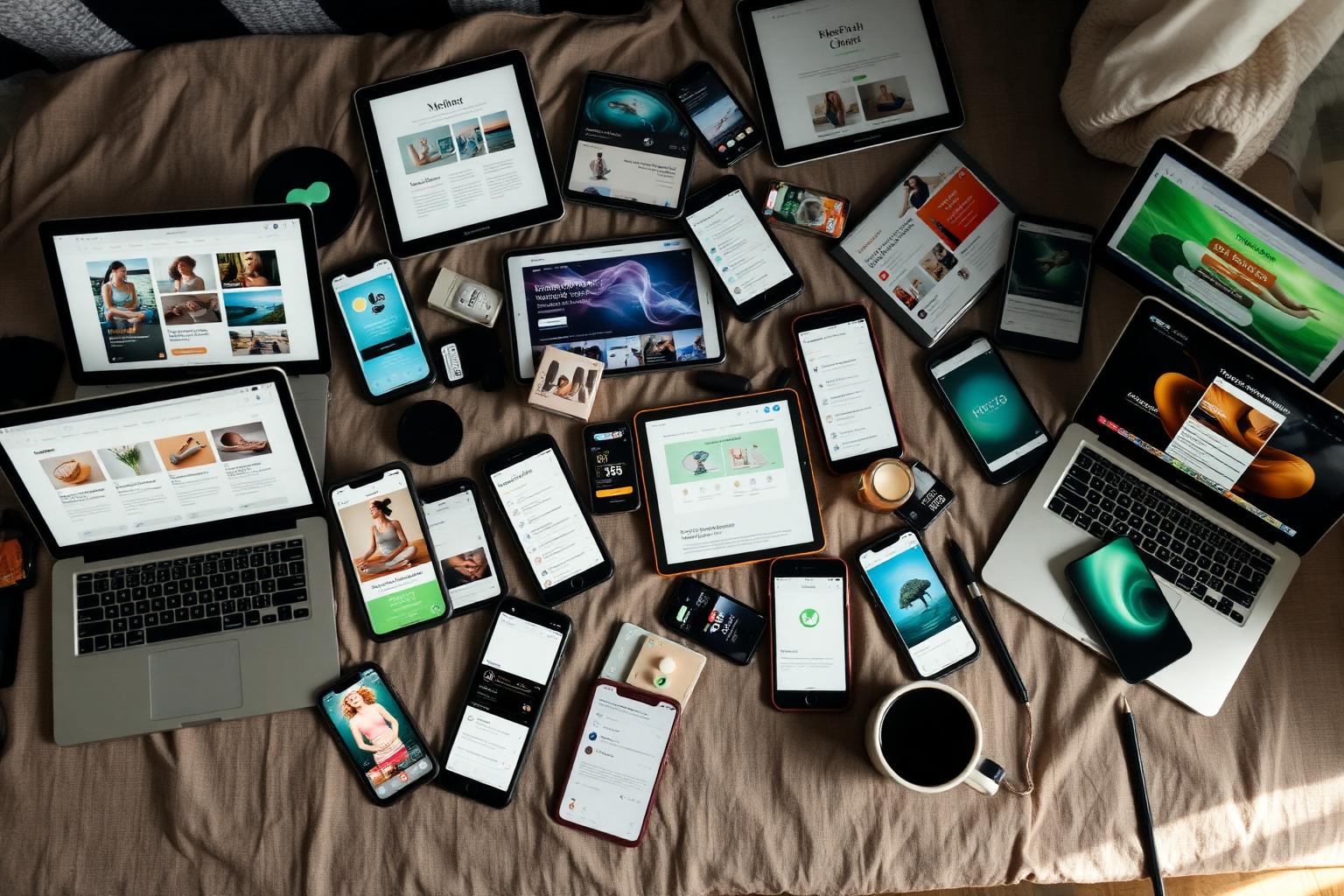
Open your phone and try to take care of yourself. Really try.
You'll book a yoga class on one app, schedule physiotherapy through a clinic portal that still emails PDFs, look up a nutritionist on Instagram, read reviews on a Facebook group, order supplements from three different stores, and ask ChatGPT what to do with your blood-test results because the lab portal hasn't been updated since 2019. Every step is on a different platform. Every platform has a different login, a different vocabulary, a different agenda.
This is what wellness "online" actually looks like in 2026. It is not a category. It is a junk drawer.
Wellness online is not a category. It is a junk drawer.
The shape of the mess
The fragmentation isn't an accident — it's the natural result of the last decade of platform incentives. Every studio built its own booking page because Mindbody fees ate their margin. Every supplement brand became a DTC site because Amazon would commoditise them. Every coach moved to Instagram because that's where attention was, and then to Substack when the algorithm changed, and then to TikTok, and then back. Every clinic kept their data locked because liability lawyers said so.
The result: there is no neutral, trusted, horizontal place to just look at wellness. There is no equivalent of Booking.com for treatments, no equivalent of IMDb for practitioners, no equivalent of Goodreads for protocols. There is Google, which gives you SEO winners. There is TikTok, which gives you whoever is good at hooks. There is Reddit, which gives you opinions from r/Supplements at 3am.
None of these are the place. They are a place. And every one of them is optimising for something other than your actual outcome.
Who pays for the fragmentation
The buyer pays in time. A study by Klarna put the average "wellness purchase research time" at 47 minutes for anything over €40 — a figure that would be laughable in flights or hotels, where comparison shopping takes a fraction of that. Time is the most expensive currency in wellness, because the people who need wellness the most are the people who have the least of it.
The practitioner pays in margin. A boutique studio in London now juggles, on average, 6 to 9 software tools — booking, payments, CRM, email, payroll, accounting, social, reviews, and at least one half-dead WhatsApp group. Each one charges 2–4% or a flat monthly. Together they swallow more of the operator's gross than rent.
The coach pays in audience. Every time a platform changes its ranking, a year of organic following evaporates. There is no portable trust layer. A practitioner with 15 years of credentials and 400 happy clients still introduces themselves on a new platform with zero followers, like an actor without an IMDb page.
A practitioner with 15 years of credentials still introduces themselves on a new platform with zero followers — like an actor without an IMDb page.
Why search and social are not enough
The standard counter-argument is: "but Google and Instagram already aggregate this." They don't. They aggregate attention. They are extraordinary at finding the most clickable result. They are pathological at finding the correct one.
A search for "best magnesium supplement" returns 12 affiliate listicles before a single primary source. A search for "physiotherapist near me" returns paid directories that haven't verified a single practitioner. A search for "is breathwork legitimate" returns whatever YouTube monetised this quarter. The infrastructure was built to sell ads, not to coordinate care.
Social is worse. Instagram and TikTok reward the version of wellness that performs well on camera — long hair, white sheets, supplement-bottle close-ups. The practitioners doing the careful, unglamorous, evidence-led work are the ones least likely to go viral. Fragmentation isn't just inconvenient; it actively misallocates trust.
The case for a single home
What would a non-fragmented wellness internet actually look like?
It would be a single place where a person could:
- Find a vetted practitioner with verifiable credentials and real reviews,
- Book the session and pay, in their own currency, with one tap,
- Cross-reference what that practitioner recommends against neutral, source-cited information,
- Track outcomes over time without handing data to a brand whose business model is selling more of itself,
- And do all of this without surrendering an inbox to twelve newsletters.
This is not utopian. This is what a hotel-booking, restaurant-discovery, or doctor-referral experience already looks like in adjacent industries. Wellness is roughly fifteen years behind on the consumer side and twenty years behind on the operator side. The only reason it persists is that no one with the right incentives has built it — yet.
What "neutral" has to mean
The catch is that neutrality is the hard part. The reason fragmentation persists is that every attempt to "unify" wellness so far has been a brand trying to sell its own protocol, a marketplace trying to push its own bookings, or a tracker trying to push its own subscriptions. The next layer — the actual one we need — has to be conflict-of-interest-free at the architectural level.
That means: no house brand competing with the practitioners on it. No paid placement that overrides relevance. No reviews that get filtered for tone. No algorithm whose job is to maximise time-on-app rather than time-to-resolution. The boring, public-utility version of a marketplace, not the engagement-optimised version.
The next layer of wellness has to be conflict-of-interest-free at the architectural level — not just in the marketing copy.
Why this is finally possible
Two things have changed. First, AI search has made aggregation cheaper than it has ever been. A model can read 400 practitioner pages, normalise their credentials, and surface the right three for a given query in under a second — work that took a vertical search company a decade and €200M last cycle. Second, consumer trust in big platforms has cracked enough that people are actively looking for smaller, vetted, opinionated alternatives.
The wellness industry doesn't need another app. It needs a place. One place a person can land and find every credible practitioner, studio, product and protocol within reach, without being sold something on the way in. That's the job to be done. Everything else is decoration.
The fragmentation is the problem. A non-fragmented home is the answer. The interesting question, in 2026, is no longer whether someone will build it — it's whether they'll build it with the patience to keep it neutral.