The deliveries arrive daily. A discreet cardboard box containing a curiously heavy vest. A sleek, matte-black mailer of powdered fungi promising focus. An invitation to a studio where the primary activity is, apparently, nothing at all. This is the tide of pitches, products, and philosophies that washes up on the proverbial desk at Codex. It’s a landscape of perpetual, often breathless, innovation.
Our job is to hold these things up to the light. To separate the genuinely useful from the merely novel, the effective from the ephemeral. Before any coach, studio, or product appears on The Codex, it undergoes a quiet but rigorous vetting. We are, by necessity, professional skeptics with an optimistic streak. We’re looking for the signal in the noise, the handful of ideas that might genuinely move the needle on human wellbeing.
What's happening
Curation, in a market this loud, is an act of editorial filtration. For every product that makes it to our virtual shelves, dozens are politely declined. For every coach who achieves ‘Verified’ status, hundreds remain as ‘Claimed’ or ‘Crawled’ profiles—data points awaiting human validation. This process isn't about gatekeeping; it's about guaranteeing a standard. Our remit is simple: if we recommend it, it’s because we’ve tested it, questioned it, and believe it works.
This vetting takes many forms. It involves our staff, a network of trusted coaches, and sometimes, early-adopter clients. A new wearable is trialled for weeks, its data cross-referenced with established benchmarks. A new supplement is scrutinized for sourcing, formulation, and third-party testing. A new studio concept is experienced firsthand, its programming and atmosphere evaluated against its promises.
This column is a look inside that process. It's a snapshot of what’s currently on the testing bench—the things that have piqued our interest, raised our eyebrows, or challenged our assumptions. These are not endorsements, not yet. They are simply the most interesting questions we're asking this month.
Why it matters now
The global wellness market is an economic juggernaut. The Global Wellness Institute (GWI) valued it at $5.6 trillion in its last major report, with projections showing unabated growth. This firehose of capital fuels a relentless cycle of product development and marketing. It’s a double-edged sword: the resources are there to fund genuine breakthroughs, but the sheer volume of output creates a paradox of choice for consumers, where more options lead to less clarity and confidence.
In this environment, trust has become the industry's most valuable and scarcest commodity. When every influencer is pushing a new adaptogen and every tech startup has a 'revolutionary' wellness wearable, how does a discerning individual make a choice? The answer is by relying on a trusted filter. A curator’s value is no longer just in finding the best, but in ruthlessly culling the rest. This is why our internal process is so deliberate; the trust our users place in a Codex match is the entire foundation of our model.
In a world of infinite wellness options, the most valuable service isn't discovery. It's disciplined, intelligent filtration.
On the Desk: August 2026
Here’s a look at the specific products, places, and programming methodologies that have our attention right now. Each is undergoing evaluation, and each represents a distinct vector of where the industry is headed.
The Peripheral: Haptic Feedback Vests
Meditation apps solved for access, but their next frontier is immersion. The challenge is deepening a practice when the primary interface is a flat glass screen. Enter the haptics. We've seen weighted blankets and compression gear, but the new wave is tech-infused apparel. We're currently testing the AuraWeave Kinetic Vest, a device that promises to translate guided meditations into physical sensations.
The vest uses an array of small vibro-tactile motors to create subtle pulses, waves, and patterns of sensation across the user's torso and back. Paired with an audio track, a guide’s instruction to “feel the breath moving through you” is accompanied by a gentle, corresponding physical sensation. The promise is a deeper, more embodied state of mindfulness, helping to anchor an often-wandering mind to the present moment. Our skepticism is centered on whether it’s a genuine tool for focus or simply a high-tech distraction. Is it somatic guidance or just a gimmick?
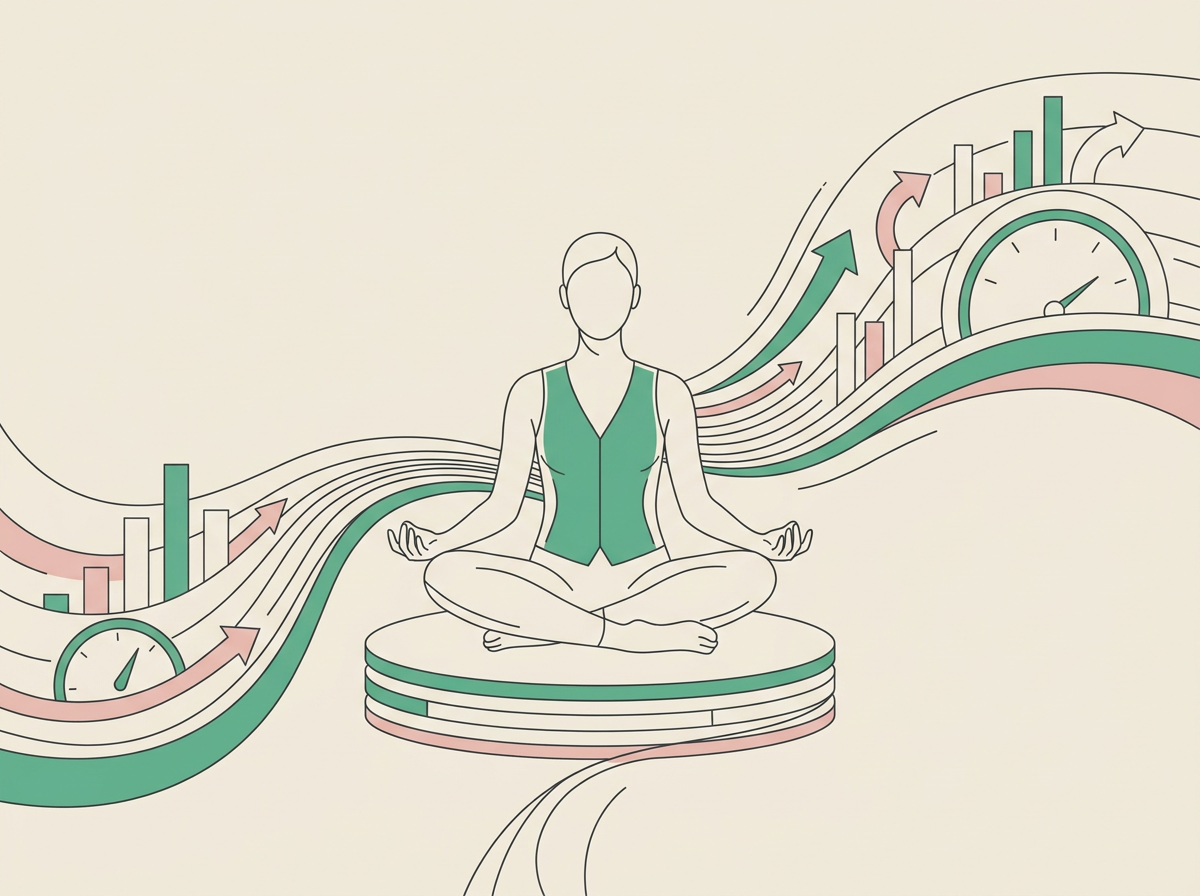
A minimalist line drawing of a person meditating wearing a sleek vest
Verdict: Promising for meditation beginners who struggle with embodiment, but could be overstimulating for seasoned practitioners. The main hurdle is whether the novelty wears off. For: The tech-curious meditator, biohackers, anyone who finds audio-only guidance too abstract. Price Band: €400 – €600
The Edible: Myco-Adaptogen Blends
Mushroom coffee was the gateway. The next evolution is hyper-personalized, algorithm-driven adaptogen blends. We're looking at Folia, a subscription service that ships monthly custom powders based on user-reported goals, sleep data from their wearable, and even stress levels inferred from their digital calendar. The user completes a detailed intake, and Folia’s system formulates a unique blend of functional mushrooms (Lion’s Mane, Cordyceps, Reishi) and adaptogenic herbs (Ashwagandha, Rhodiola).
The premise moves beyond the one-size-fits-all “focus” or “calm” blends. Your formula might be adjusted month-to-month; more Cordyceps ahead of a marathon, more Reishi during a stressful work period. The appeal is obvious: true personalization. Our vetting focuses on two things: the sourcing and potency of their ingredients, and the scientific validity of the algorithm. Is the AI just a marketing narrative, or is it creating genuinely more effective formulations? The jury is out, but the model is compelling.
Verdict: A fascinating application of personalization to supplements, but its efficacy hinges on the transparency and intelligence of its algorithm. For: The quantified-selfer, supplement-savvy professionals, those tired of generic off-the-shelf products. Price Band: €70 – €120 monthly subscription
The Studio: “Deliberate Boredom”
In a fitness landscape dominated by strobing lights, leaderboards, and ever-escalating intensity, a new studio concept is proposing a radical counter-movement: doing nothing, together. We recently visited Still, a studio in Berlin where the main class is called “The Void.” For 45 minutes, a small group sits or lies in a softly lit, acoustically-engineered room. There is no guide, no music, no phone. The goal is not meditation, but simply to be present with your own thoughts, without stimulation or objective.
This is the commercialization of “deliberate boredom.” The theory is that our brains, constantly saturated with input, have lost the ability for idle, non-linear thought—the very state that fosters creativity and self-reflection. The studio provides the container and the social contract to enforce it. It feels absurd at first, then deeply uncomfortable, and finally, for some, revelatory. We’re assessing whether this is a durable concept or a niche indulgence. Can you charge a premium for structured nothingness? The answer, it seems, might be yes.
Verdict: A potent, if challenging, antidote to modern overstimulation. Its success depends on whether people are willing to pay to be bored. For: The creatively blocked, the chronically burnt-out, recovering doom-scrollers. Price Band: €25 – €35 per session
The Methodology: AI-Assisted Coaching
Perhaps the most significant trend we’re tracking is not a product, but a process. Top-tier coaches on our platform are increasingly using AI not to replace their expertise, but to augment it. They're adopting specialized software that synthesizes client data—workout logs, HRV from a wearable, subjective feedback scores—to flag trends and suggest programming adjustments. This allows a coach to move from a weekly check-in to a near real-time feedback loop.
The AI might note that a client’s sleep quality consistently drops after evening training sessions and prompt the coach to suggest a switch to morning workouts. Or it might correlate a dip in motivation with a specific type of exercise and recommend an alternative. The coach remains the strategist and the human connection, but the AI becomes a tireless analyst, freeing them up for higher-value interaction. We are watching this closely, as it represents a fundamental shift in the coaching paradigm from static plans to dynamic, data-responsive guidance.
The best technology won't replace a great coach. It will give them superpowers, automating the analysis to free them for human connection.
What this means for you
The ever-shifting landscape of wellness can be overwhelming. These trends—somatic tech, personalized nutrition, radical rest, and AI-powered coaching—highlight a move towards more precise and individualized solutions. But they also underscore the need for a trusted guide. You don’t need to become an expert on haptic vests or mycology to benefit from these innovations.
That's our role. The products and studios that pass our vetting will eventually appear on /products and /studios. The coaches pioneering these new methods are the ones you'll find when you complete the Codex intake. Our job is to do the homework so you can focus on the work itself. Whether you’re an individual seeking a change or a company looking to empower your team with Codex Credits, the principle is the same: access to the best, without the noise.
Verdict
The future of wellness appears to be a blend of the hyper-technical and the profoundly simple. We see a path for AI-driven personalization to coexist with the structured, silent boredom of a studio like Still. What unites them is a focus on targeted, effective interventions. As we continue our testing, our commitment remains the same: to surface the rare few things that truly work.
FAQ
What are the Codex trust tiers for coaches?
Codex has three tiers: 'Crawled' profiles are publicly listed data; 'Claimed' profiles are managed by the coach themselves; 'Verified' coaches have been vetted and approved by the Codex team for quality and credentials.
Why is curation so important in the wellness market?
The wellness market is a multi-trillion dollar industry saturated with products and services. Curation by a trusted source helps consumers cut through the noise, avoid ineffective solutions, and find options that are safe, effective, and suited to their needs.
What is a haptic vest?
A haptic vest is a piece of wearable technology that uses vibration motors to create physical sensations on the body. In wellness, they are being used to complement meditation or VR experiences, translating audio or visual cues into tactile feedback to deepen immersion.
Will AI replace wellness coaches?
The current trend suggests AI will augment, not replace, human coaches. AI tools can handle data analysis and pattern recognition, freeing up coaches to focus on strategy, motivation, and the human connection that is crucial for success.